
From Army veteran to Fractional Chief AI Officer.
I embed as a fractional AI executive inside growing companies — owning the strategy, evaluating the tools, and making sure every automation dollar drives measurable ROI. Founder of AutomateNexus, author of The AI Automation Field Manual.
Most AI initiatives fail because they're treated as experiments, not operations. I treat them as missions.
Most AI initiatives die the same death: a vendor sells a tool, nobody owns the strategy, and six months later the license is shelfware.
I've seen it 100+ times. The companies that extract real value from AI have one thing in common — senior leadership owning the AI function. Not a CTO adding it to an already full plate. Not a consultant who drops a report and disappears. An embedded operator who owns outcomes.
That's why I serve as a Fractional Chief AI Officer — embedding into leadership teams to own the AI roadmap, evaluate every vendor decision, and ensure implementation drives revenue within 90 days. The agency handles execution. I handle the thinking.
The companies that treat AI as a mission, not an experiment, are the ones still standing when the hype cycle ends.
Three ways to engage.
One embedded operator. Three depths of engagement — from a single decision to a standing seat at your leadership table.
in documented client savings
AI implementations delivered
day ROI target — every engagement
active client cap — limited availability
Documented outcomes, in motion.
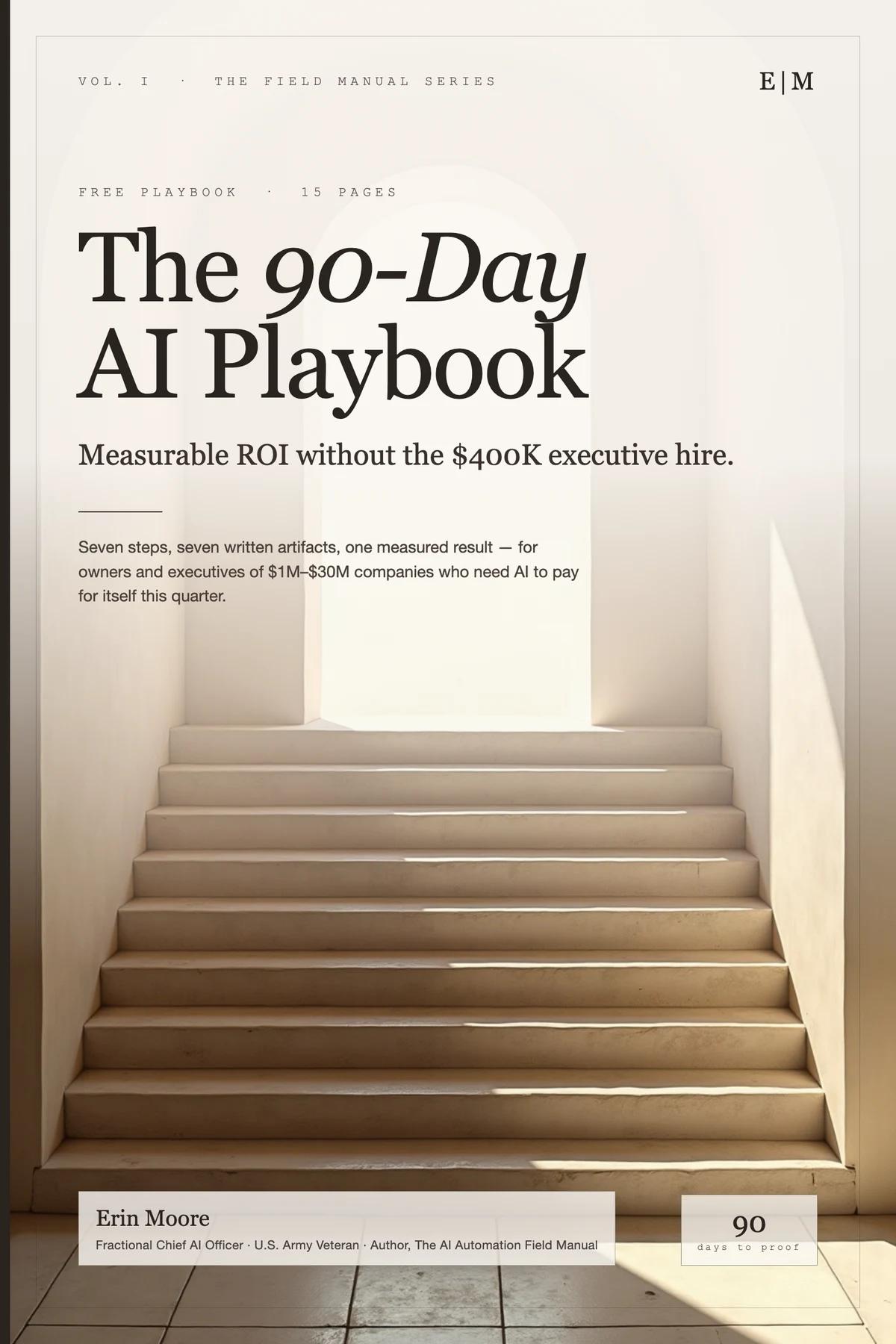
Measurable AI ROI in ninety days,
without the $400K hire.
Seven steps, in order, each ending in a written artifact you can hand your leadership team tomorrow: an honest readiness score, a one-page AI policy, one automated workflow with a measured return, a vendor scorecard that prices the exit, and a board update with four numbers and zero adjectives.
- 01The same method used across 100+ implementations
- 02Readiness score on day one, governance by day seven
- 03No platform purchase in the first sixty days
- 04Fillable rubrics, a 12-question vendor list, a 90-day scorecard
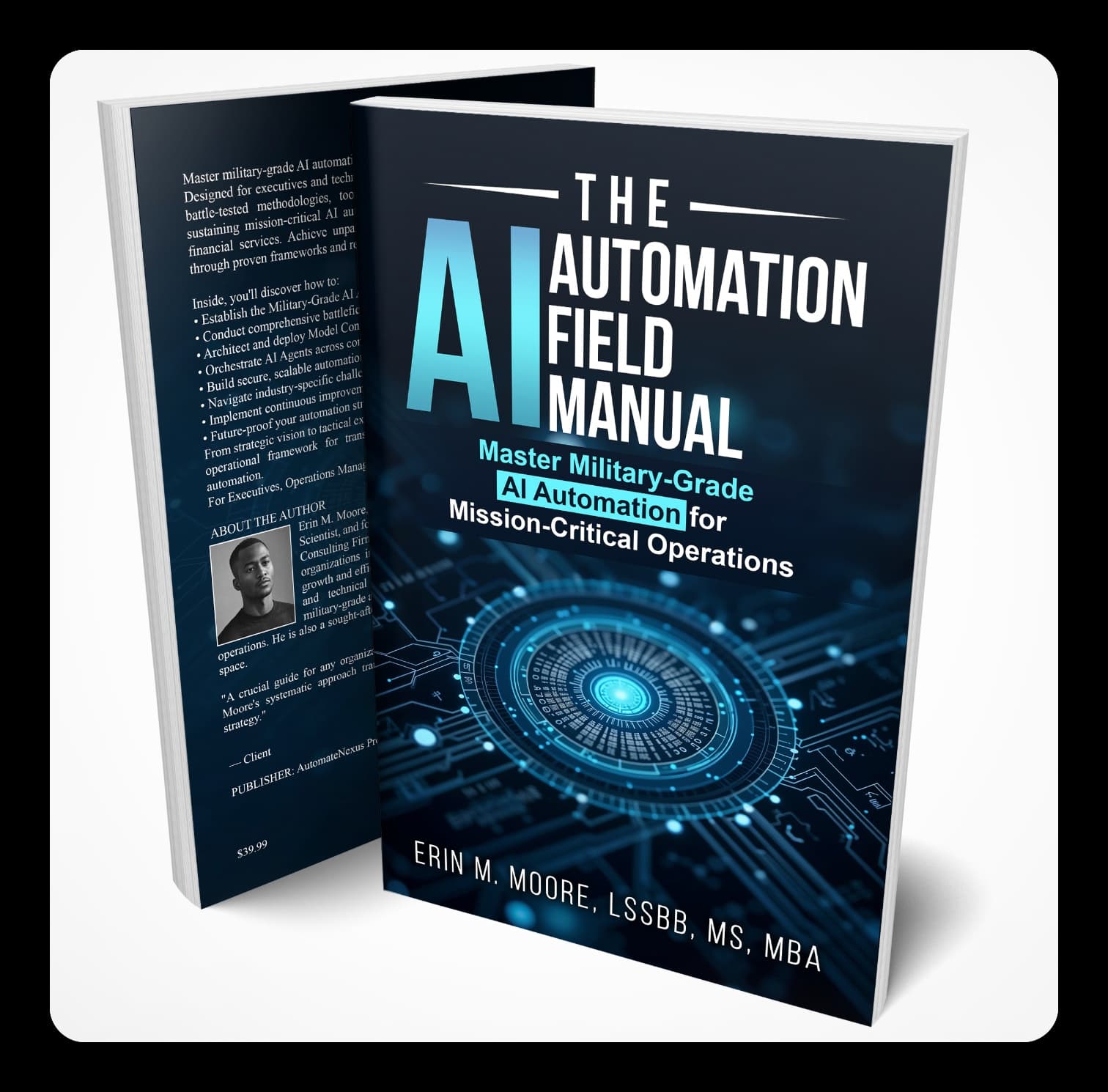
The AI Automation
Field Manual
Battle-tested frameworks for building automation systems that deliver consistent results under any conditions. Military-grade discipline applied to enterprise AI.
“Most companies invest millions in AI automation that works beautifully in controlled environments—then breaks under real-world pressure. This book is the antidote.”
Recent essays.
What Is a Fractional CMO, and Do You Need One?
Most companies who think they need an agency need someone to decide what the agency should do.
Does the EU AI Act Apply to a Small Business?
Most small businesses are not building high-risk AI. Some are caught anyway, and the deciding factor is not where you are based.
AI Vendor Lock-In Is a Purchase-Time Decision
Lock-in feels like a renewal problem. It is created on the day you sign, and it is cheap to prevent then.
If our values align,
let's build something.
Whether you're exploring AI automation, looking for a speaker, or just want to connect — I read every message personally and respond within 24-48 hours.
Common questions
- What does a fractional Chief AI Officer actually do?
- A fractional CAIO holds a standing seat in your leadership team and owns the AI decisions: which use cases to pursue, which vendors to buy, how governance works, and whether the spend produced a return. It is an accountability role, not an implementation role — the work is judgment, exercised continuously, rather than a project with a deliverable.
- How is this different from hiring an AI consultant?
- A consultant is engaged for a project and is measured on the recommendation they hand over. A fractional CAIO is embedded, attends leadership meetings, and is measured on whether your AI portfolio improves over time. If you need a decision made once, hire a consultant. If you need decisions made continuously, you need the seat filled.
- What does it cost?
- Fractional executive retainers in this market typically run $5,000 to $30,000 a month depending on scope and decision rights. The comparison that matters is against a full-time Chief AI Officer package, which generally lands between $300,000 and $550,000 in total compensation — not against a consultant's project fee.
- How quickly should we expect results?
- The first 90 days should produce a decision you can act on, not a report. That usually means a short list of use cases worth funding, a list of ones to stop, and a measurement baseline so the next quarter can be judged honestly. Transformation takes longer; clarity should not.
- Do we need a data team already in place?
- No, though it changes the sequence. Without technical staff, more of the early work is deciding what to buy rather than what to build. Part of the role is making that call deliberately instead of defaulting to whichever vendor got in front of you first.
- How do I know if we are ready?
- The free AI readiness assessment scores you across data, process, people and governance in about three minutes and tells you which dimension is actually holding you back. Most companies discover the constraint is process or people, not technology.